











Single Page vs Multi Page Website Pros & Cons

By Karthi | August 5, 2026










There is a lot more to building a website than we imagine when we first start. One of the most peculiar yet intriguing debates for us and for visitors alike is choosing between a single page vs multi page website.
Let’s bring that debate to a conclusion with the information covered in this article, so you can choose the option that suits your needs.
What is a Single Page Website?
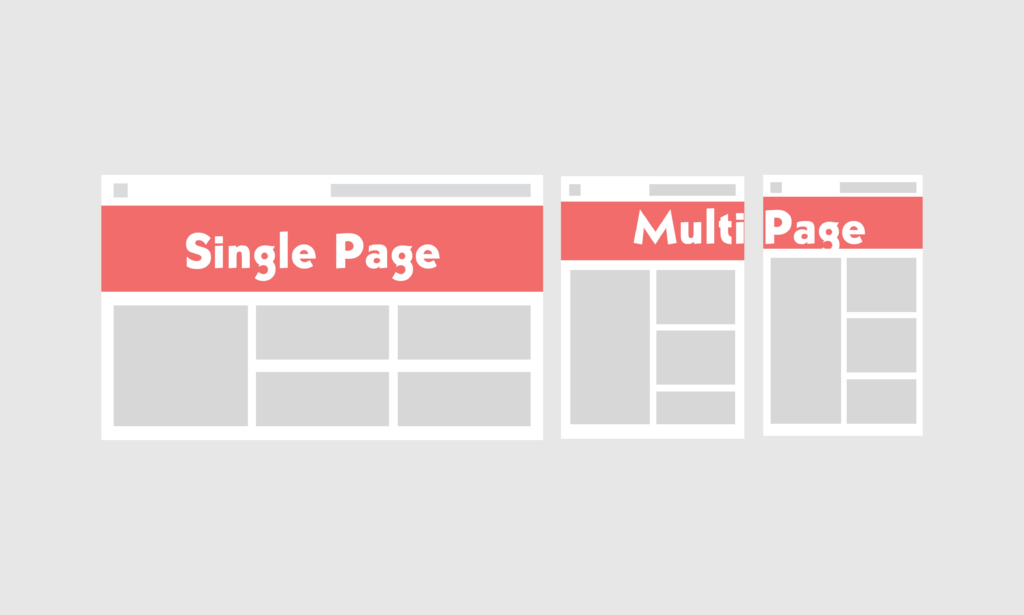
A one-page website, or single-page website, displays all key information on a single page. Instead of a menu that leads to different pages, links scroll directly to specific sections on the same page.
For example, selecting “About” from the menu scrolls the browser to the About section rather than opening a new page. When you compare Single Page vs Multi Page website, this specific functionality gives you slight edge over multi page website as it easier to navigate within same page.
Pros:
Comparing Single Page vs Multi Page website, having all content consolidated on a single page helps focus the user’s attention on one main topic or idea. This design also provides additional benefits for both website owners and visitors, including:
- Simple navigation
- Better mobile experience
- Digestible content
- Quicker boost in page authority
- Higher conversion rate
Simple Navigation
One-page websites emphasise simplicity. Without links or multiple menus, users usually browse the content directly, with options to scroll down or up.
Visitors can select a menu option to jump to specific information on the page swiftly. Between Single Page vs Multi Page, Single-page layouts provide a tidy, distraction-free experience with no extraneous steps or clutter to locate relevant content.
Better Mobile Experience
Simple navigation improves the mobile experience by enabling smooth scrolling and reducing links, which makes browsing much easier.
One-page websites frequently employ “lazy loading” to achieve faster load times and minimise bandwidth consumption. This technique initially loads only the content visible on the screen, with additional content being loaded dynamically as the user scrolls down.
This feature offers several benefits for users. Because only a portion of the content loads initially, users can connect more quickly. This is especially important since mobile users tend to abandon sites that take too long to load.
Since only specific images and code are rendered, the user’s device conserves system resources, reducing the risk of freezes or crashes on devices with limited memory.
Digestible Content
Single-page websites present all essential information on one page, organised into clearly defined sections.
The page uses a linear layout to direct readers towards a specific action, ensuring they don’t navigate unpredictably between pages.
A user can easily scroll from top to bottom, taking in key information complemented by vivid imagery without feeling overwhelmed.
Quicker Boost in Page Authority
Although not a primary focus for one-page websites, SEO still offers a chance to build authority via link-building.
Domain Authority (DA) and Page Authority (PA) are metrics used by Moz to estimate how well a website may rank in search engines. As your site gains more backlinks, your authority scores typically increase, improving the chances of your site appearing in search results.
Additionally, a single-page website consolidates all links into one URL instead of multiple pages. This can also help improve your DA and PA scores.
Higher Conversion Rate
Narrow-focused, single-page websites are highly effective for lead generation, making them ideal for landing pages. They capture visitors’ attention and showcase your offer clearly without the clutter of multiple pages.
Easy Navigation
One-page websites are easy to navigate since all content resides on a single page. Including a menu at the top can further streamline access. This menu’s links will point to anchors within the same page, minimising the chance of visitors losing their way, a common issue on multi-page sites. Due to the site’s structure, it’s best to keep the menu links limited to just a few.
Mobile Friendly
Developing a mobile friendly website with single-page code is easier than converting a multi-page website. Users can browse a one-page site with just scrolling, making it very convenient on mobile devices. Additionally, not having a traditional menu makes navigation even simpler on mobile.
Better User Experience
Of Single Page vs Multi Page, the websites are very user-friendly on one page websites because users can effortlessly scroll through all the content without needing to navigate across multiple pages. This simple design, avoiding complex menus or a large number of pages, improves the overall user experience.
Clean Layout
A minimal menu, streamlined content, and optimized images that fit on a single page without taking up too much space foster a clean overall layout. This design directs visitors’ attention to your product or service and the Call to Action button. To achieve a professional appearance, keep your content as concise as possible.
Higher Conversion Rates
You can improve your conversion rates because visitors won’t be distracted by other content or navigation options that might lead them away. Landing pages on multi-page websites are often designed to resemble a single-page site focused on a specific goal.
Cons:
Navigation
If a page is very long, relying only on anchors rather than actual menu links to internal pages can slow navigation, as there is no menu to quickly jump between sections. Too much scrolling can also frustrate users. Although a search button isn’t mandatory, not having one might disappoint users who expect it, possibly decreasing their overall experience.
Limited Space
Between Single Page vs Multi Page, single page website provides limited space for content, so you may not be able to include all the text, images, or infographics you want. While there’s no standard for the ideal content length, having more content lessens the chance that visitors will scroll to the bottom. This can greatly hinder your website’s growth.
Limited SEO Options
Reducing content on your website may harm your search engine optimization because fewer keywords can cause search engines to overlook your site or only show your domain name in search results, rather than a specific, topic-related URL as seen with multi-page websites.
Hard to Share or Track
If all your content is on a single page, it becomes much harder to share links to specific sections or use analytics to track different parts of the site.
What is a Multi Page Website?
Multi-page websites are made up of multiple pages, each with a unique URL, connected through navigation menus. Unlike single-page websites where all content is on one page, multi-page sites divide content into separate pages, each designed for a specific purpose and containing targeted information.
For example, a typical multi-page business website can have:
- A Homepage
- An About page
- A Services or Products page
- A Contact page
- Additional pages, like Blog, FAQ, or Portfolio
Pros:
Scalability
You can add unlimited pages, removing worries about your website’s expansion. If you want to offer more products or expand existing content, it’s straightforward to do. This is particularly important if you are building a e-commerce sites with many items. A multi-page website allows for easy updates and regular addition of fresh content.
Better SEO
Adding more pages enables the inclusion of more SEO-driven content, such as extra keywords and meta tags, which can increase the chances of external sites linking to your website. It also raises the likelihood of search engines indexing your site on different topics. For better results, think about including a blog. A multi-page website greatly strengthens your SEO efforts.
Multiple Keyword Opportunities
The main downside of one-page websites is also the biggest benefit of multi-page sites: they can target multiple keywords. Each page on a multi-page website enables you to optimise for and rank for different keywords.
In the New York plumbing business example, your homepage should centre around the keyword “New York plumber,” while other pages can target common terms such as “licensed plumbers NYC” or “emergency plumber NYC.”
Blogging Capabilities
While you can create a blog and link it from a single-page website, multi-page sites allow you to publish blog posts directly on your main domain.
This draws organic traffic straight to your website, enabling visitors to browse other pages and discover more about your business. Ultimately, each blog post acts as an extra entry point that can help increase conversions.
Content Siloing
Content Siloing is an SEO strategy that organises related content into structured clusters or “silos” centred on specific topics.
For instance, a fitness website could structure its content into separate sections for nutrition, workouts, and supplements, with each section containing multiple related pages that connect to each other.
Multi-page websites are well-suited for building content silos because they enable the allocation of entire site sections to different topics. Each silo can have its own landing page, along with subcategories and supporting pages.
This organized setup helps search engines identify your expertise in different topics and can improve your rankings for associated keywords.
Cons:
Maintenance:
Larger websites are harder to maintain than single-page sites because updating content across multiple pages takes more time. Managing different modules or platforms, like a CMS for the main site and another for a blog, further increases update times and the chance of encountering issues. Moreover, since search engine algorithms frequently change, handling more content makes it more time-consuming to adjust to new standards.
Less User-Friendly on Mobile:
Building a mobile-friendly multi-page website can be more complicated because each page requires separate adjustments. Certain pages or extensive menus might not render properly on mobile devices, which can decrease user-friendliness. Even if you create a mobile version, managing both desktop and mobile sites will demand more time.
More Distracting:
Having more pages and menu links can increase the chances of visitors getting distracted and exploring various parts of the site, which might reduce the time they spend on each page. If your goal is to sell a product or service, such distractions could lower your conversion rates.
Bounce Rate Increase:
Your bounce rate shows the percentage of visitors who leave your website after viewing just one page. For sites with only one page, this isn’t an issue since there’s only a single page to look at.
Multi-page websites can have high bounce rates because they consist of several pages, each potentially facing different problems, such as:
- Slow-loading pages
- Irrelevant content that doesn’t match visitor expectations
- Broken links
- Poor user experience design
- Content that doesn’t align with page titles and descriptions
Monitor your website’s bounce rate regularly to spot areas that need attention.
Multi-page layout is more suitable for:
- Online stores
- Blogs
- Corporate websites
- Social networks
Factors to Consider Between a Single Page vs Multi Page Website:
Deciding between a Single Page vs Multi Page website depends on your business needs and goals. Remember these two key factors when making your choice.
Your website content:
What do you offer, and how effectively do people grasp your message? Are you able to communicate your offerings concisely, or must you inform and persuade your audience about what you provide?
For example, if you’re a wedding photographer or operate a food catering service, people instantly understand your profession without requiring multiple pages to explain it.
However, a one-page website may not be suitable if you have multiple products or services needing detailed descriptions. Attempting to fit all that information on a single page can result in a cluttered and overwhelming site.
Use a content-focused approach by pinpointing what is important to your customers. Find out what they need to see to make an informed decision about your business.
Single Page vs Multi Page gives its challenging to choose from. If it’s challenging to fit everything on one page or if you need multiple categories, think about using a multi-page site template.
Your marketing strategy:
Where is your audience mainly arriving from? To choose between Single Page vs Multi Page, determine where you are audience are mostly arriving at or looking for.
If most find you via word-of-mouth, social media, and search rankings are less important, a single-page website can suffice.
A multi-page website is beneficial for increasing traffic through SEO and advertising. It enables the use of blogs and landing pages to target different keywords efficiently.
Conclusion:
Choosing between a single page vs multi page website largely depends on personal preference. There are no strict guidelines for when to select one over the other, and neither is inherently superior. Different types of websites benefit from different approaches. Weigh the pros and cons of each to decide which best fits your needs.
A single-page website allows visitors to see all content at once, even on mobile devices, and is easy to create and manage. However, it limits the amount of content you can add, which might restrict your site’s growth. It can also limit SEO capabilities and sharing options.
A multi-page website provides more SEO content and improved navigation, but it usually costs more and is more complex to develop and maintain. Additionally, it may not display optimally on every device.